





The Estate of Polixeni Papapetrou (1960–2018)
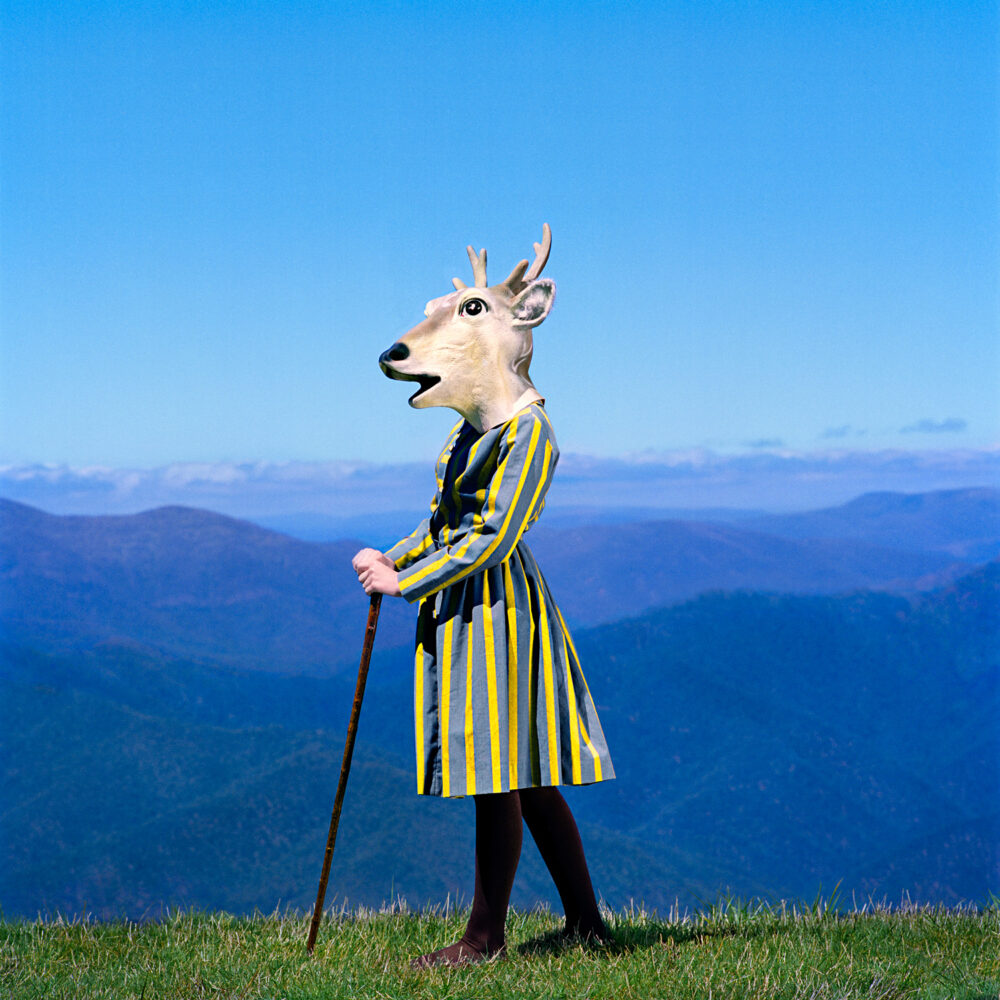
Papapetrou was one of Australia’s most original and influential artists, widely recognised for her rigorously staged, psychologically charged and conceptually ambitious explorations of childhood, identity, performance and representation. Emerging in the late 1980s, she rejected Australia’s entrenched documentary tradition, instead constructing meticulously choreographed visual worlds through costuming, theatrical mise-en-scène, historical quotation and symbolic landscape. For Papapetrou, the photograph was never evidence – it was imagination made visible, a cultural proposition rather than a record.
A defining hallmark of her practice was her long creative collaboration with her children, particularly her daughter Olympia. Rather than romanticising or sentimentalising childhood, Papapetrou understood it as a dynamic site of transformation, agency and psychological complexity. In acclaimed series such as Haunted Country, Dreamchild, Between Worlds and The Ghillies, children appear masked, costumed or inhabiting uncanny spaces, embodying mythic, literary, colonial and archetypal roles. These works are not portraits of children, but portraits of becoming – that probe how identity is shaped by narrative, expectation, belonging and cultural inheritance.
Her work also carried intellectual and ethical force. In 2008, when a photograph of Olympia became entangled in a national debate about censorship and the representation of children, Papapetrou defended artistic freedom with measured clarity and dignity, insisting on the integrity of collaboration, consent and care. She refused sensationalism, instead elevating the conversation around art, fear and public morality. That exchange cemented her as a critical voice within Australian cultural discourse.
Papapetrou exhibited widely across Australia, Europe, Asia and the United States. She participated in major international photography festivals including Photolux Festival of Photography, Lucca (2017); Lishui Biennial Photography Festival, China (2017); European Month of Photography, Berlin and Athens (2016); Daegu Photo Biennale, Korea (2016); Dong Gang International Photo Festival, Korea (2014); Fotográfica Bogotá, Colombia (2013); Photofestival Noorderlicht, The Netherlands (2012); 3rd Biennale Photoquai, Musée du quai Branly, Paris (2011); Month of Photography, Bratislava (2010); Pingyao International Photography Festival, China (2010); Athens Festival of Photography, Athens (2010); FotoFreo, Perth (2008); Seoul International Photography Festival, Seoul (2008); and Le Mois de la Photo, Montreal (2005). Over the course of her career, she presented more than 50 solo exhibitions and over 100 group exhibitions worldwide.
Her achievements were recognised through numerous grants from the Australia Council for the Arts and Arts Victoria, alongside major awards including the William and Winifred Bowness Photography Prize (2017), the MAMA Art Foundation National Photography Prize (2016), the Windsor Art Award (2015), the Josephine Ulrick and Win Shubert Photography Award (2009) and the Albury Regional Art Gallery National Photographic Award (2003).
Papapetrou’s work is held in significant institutional and private collections, including the National Gallery of Australia, Canberra; National Gallery of Victoria, Melbourne; Art Gallery of New South Wales, Sydney; Museum of Contemporary Art Australia, Sydney; Queensland Art Gallery | Gallery of Modern Art (QAGOMA), Brisbane; Bendigo Art Gallery, Victoria; Geelong Gallery, Victoria; Monash Gallery of Art, Melbourne; Fotomuseo, Bogotá, Colombia; Museum of Fine Arts, St. Petersburg, Florida; Landstinget Gävleborg Kulturutveckling, Sweden; the Wesfarmers Art Collection, Perth; BHP Billiton, Melbourne; and Artbank, Sydney.
Survey exhibitions were held at the Centre for Contemporary Photography, Melbourne (2013) and the Australian Centre for Photography, Sydney (2011), culminating in a major retrospective at the National Gallery of Victoria (2019). Her international significance was further underscored when she became the only Australian artists to receive an obituary in The New York Times.
Papapetrou’s legacy endures – formally, intellectually and emotionally. She expanded the possibilities of staged photography in Australia, influenced generations of artists, and left a body of work that is tender, unsettling, deeply thoughtful and fiercely imaginative. Her images continue to invite viewers to look harder, think deeper and recognise identity not as fixed, but as an unfolding act of creation.
For access to specific works in the full back catalogue of Polixeni Papapetrou, please contact tobymeagher@michaelreid.com.au